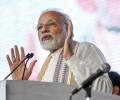
Modi said his government was committed to provide equal opportunities to all sections of the society.

Foreign investors hiked their stake in Infosys to a nine-year high of 42.10 per cent in the January-March period of 2014.

'Investors should be careful in getting carried away; although a reversal of IPO frenzy this time is taking longer than in the past.'

The broader NSE Nifty rose nearly 124 points to settle just below the psychological 11,000 level.

Among other things, the agenda is likely to focus on increasing private investment, employment generation and giving relief to the farm sector

More than 40% of the companies surveyed showed job contraction in FY18, says a report by CARE Ratings

Corrective measures are already being taken by fund managers - overall allocation to the IT firm has been pruned by 120 basis points, from 4.43 per cent in March to 3.24 per cent in July

Analysts, however, predict it would be an uphill climb for export-reliant China's economy going forward as it faced intensified conflict with the US and the negative fallout on its external trade due to Beijing's increasingly aggressive policies towards countries like India resulting in bans of its products and services.

The world's biggest lockdown that shut a majority of the factories and businesses, suspended flights, stopped trains and restricted movement of vehicles and people, may have cost the Indian economy Rs 7-8 lakh crore during the 21-day period, analysts and industry bodies said.

Starting with the third quarter of financial year 2020-21 (Q3FY21), we have seen "unlock" trades at various times. Whenever lockdowns have been eased, traders have taken long positions in consumer-facing businesses. Let's look at the logic. Since March 2020, sectors like retail, personal vehicles, hospitality, aviation, fast-moving consumer goods (FMCG), multiplexes, etc., have been under severe pressure. As a result, there's been a low base effect. Every company in these spaces has suffered top line contraction. Many suffered losses, especially in the first half of FY21.
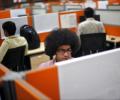
Recently, when TCS laid off a handful of employees, prominent trade unions rushed to offer their support to workers who had lost their jobs.

Companies in the small-cap universe are having a dream run - the Nifty Smallcap 100 index has shot up more than 25 per cent on a year-to-date basis, even as the benchmark Nifty is up 7 per cent. This is the best start for the index since 2017 when the Nifty Smallcap 100 index surged 32.3 per cent between January 1 and May 10. However, in terms of outperformance to the Nifty, this year's performance is the best in more than a decade. A combination of sectoral tailwinds and lack of institutional selling pressure has helped small companies escape from the correction triggered by the second wave of Covid-19.

Gold, forex assets, IT sector, pharma. Devangshu Datta explains why each of these is a good hedge against market shocks at this time.

While most experts suggest the government loosen its purse strings and not worry about the fiscal deficit in a pandemic impacted year, it will be a tightrope walk for the government to increase spending without going overboard.

There were nearly 4,000 cabin crew with Jet when the airline was grounded; every fifth remains without a job to date. One cabin crew member with 10 years of experience has been forced to take up a teaching job; some have branched out into small businesses. Aviation jobs were scarce even before the Covid-19 pandemic arrived on Indian shores in early 2020. The situation has been exacerbated since.
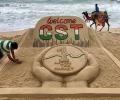
GST collections in February grew 18 per cent to over Rs 1.33 lakh crore in February even as the Omicron wave dented the month-on-month collection momentum. This is for the fifth time in the current fiscal that the Goods and Services Tax (GST) collection has crossed Rs 1.30 lakh crore mark. Also, this is the first time, cess collection has crossed the Rs 10,000 crore mark, signifying recovery in certain key sectors, especially automobile sales, the finance ministry said on Tuesday.

Through the IPO, Burger King has raised Rs 450 crore, which will be used to rollout new outlets and retire debt.

Banking and telecom will see the highest impact of this transition.

S&P Global Ratings on Thursday said the Indian economy is projected to grow at 11 per cent in the current fiscal, but flagged the "substantial" impact of broader lockdowns on the economy. In its report on Asia-Pacific Financial Institutions, S&P said the control of COVID-19 remains a key risk for the economy. New infections have spiked in recent weeks and the country is in the middle of a second pandemic wave.

Yes Bank led the laggard's list on the Sensex with a nearly 10 per cent drop after Moody's Investors Service downgraded the private sector lender's ratings. Other top losers were SBI, IndusInd Bank, Tata Motors, Mahindra and Mahindra and HDFC.

From the pandemic shocks to state polls to global trends, a raft of sentiment drivers are expected to steer the Indian stock market in 2022 after a historic year of massive investor returns and milestones. The Union Budget, which will be closely watched for further reform moves, and quarterly earnings of corporates will be among the developments on investors' radar amid global central banks moving towards tighter interest regime in the wake of inflationary pressures. The year 2021 was rewarding in a big way for equity investors.

'Internet, healthcare and life insurance are a few sectors which offer solid long-term decadal potential.'

We live in hope that India and its airlines might finally grow up, notes Anuli Bhargava.

'The term 'pro-growth' must be qualified somewhat because, while a rising tide will lift all boats, it will not necessarily do so equally.'

Markets have gone into a tailspin, the Modi govt must revive investment sentiment.

The BJP government is no better than the Congress -- as wretched and anti-people. In addition, it is explicitly and aggressively communal, says Venkatesh B Athreya, in a hard-hitting interview to Shobha Warrier/Rediff.com.

The economy can't grow without increasing electrification, which requires more power plants, and given coal is the cheapest form of fuel and is abundant, it makes sense that India is looking to boost the use of the fuel.

Despite taking a hit on profitability amid the pandemic, companies with strong balance sheets are gaining market share because of consolidation in their respective sectors.

The broader NSE Nifty fell 78.75 points, or 0.70 per cent, to close at 11,234.55.

The internals of the food inflation are worrying, given a broad-based uptick across categories that tend to be sticky, such as proteins, and a narrower-than-expected reduction in inflation for vegetables.

The flow of economic news suggests that "good days" are not here as yet.
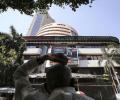
In the broader markets, the BSE Midcap and Smallcap indices extended gains and were up over 1% each

With nearly 100 countries closing national borders during the past month, the movement of people and tourism flows have come to a screeching halt. The contraction could be even higher if governments fail to provide income support and help boost consumer spending.

The unemployment situation is becoming increasingly acute.

Analysts attribute this fall to the recent moderation in energy (mainly crude oil) and commodity prices, lowering of input costs for companies in sectors such as FMCG, consumer durables, and automobiles, reports Krishna Kant.

We should brace ourselves for more bad news in the coming quarters -- on economic output and growth, strains on the fiscal deficit, export slowdown, small and micro enterprises in distress, and further accumulation of NPAs in the banking sector, says Rahul Khullar.
Every time the Indian economy has faced headwinds due to international developments, the oil sector has played a crucial role, explains A K Bhattacharya.
Analysts factor in 200-300-bps impact on sales in FY16

The central bank's currency management will be critical over the next few months. A weaker rupee could help to revive exports. But, the currency must fall slowly and in controlled fashion, says Devangshu Datta.

Trade, transport and hotels form a major part of the country's GDP and these sectors were crippled by the strike
